RReuters · 14 min ago
Fed signals two more cuts this year as inflation cools faster than expected
BullishMacroReliefNVDASPY
A news analyst that works all night, on a Mac Mini. A financial news intelligence platform for a professional trader: it reads the market around the clock, separates signal from noise and tests every idea against real prices. We designed and built it end to end, from the first screen to the models that run it.
Custom software. Local AI.
One continuous flow from news to signal.
Less noise.
More context.
Client
A professional trader (anonymous)
Role
Lobos Design: product design, UX/UI, full-stack development and AI engineering
A professional trader spent their days reading dozens of outlets, Telegram channels and social posts, and copying prices by hand into a spreadsheet. The problem was never a lack of news. It was the opposite: too much of it, all shouting at the same volume, with no way to tell what actually moves a stock from what only makes noise.
Their rule was simple: "if I buy ten newspapers and the same story is on all ten front pages, that's the theme." No tool on the market showed them that.
We built ANS around two questions instead of one score:
The gap between the two, the spread, is the product. A loud story that matters little is noise to step around; an important story almost nobody is talking about is an edge for whoever reads it first. The rest of the work was turning that into an interface a trader reads in seconds, on the desk and on the phone.
A custom AI platform, running on one Mac Mini in a private network.
Designed around one trader’s workflow, with local models, application logic and storage on the same machine. Privacy is an architectural decision: the core runs locally, while external integrations have an explicit role.
Classification, extraction and scoring run on models hosted on the Mac Mini. The core intelligence runs next to the application and its database.
Almost all model calls are local. Selected cloud integrations remain available for specific tasks.
External connections, made explicit. News and prices arrive from outside. Optional Groq / Grok integrations and Telegram connect to external services. Core inference and storage run locally; social research has a $10/month cloud cap.
Local firstTwo questions. Two scores. The difference is the signal.
How much does a story matter to the market? How much attention will it attract? ANS keeps these questions separate. Explore how the spread changes when importance and attention move apart.
A loud story is not automatically an important one.
Six connected stages. A clear responsibility at every step.
From collecting public sources to delivering a checked briefing, each stage does one job. Follow the story through the system to see where models contribute, where code takes over and where the trader stays in control.
News wires, filings, market prices, X and Telegram enter a shared pipeline. The original source remains attached to each story.
One workspace. A complete reading of the market.
Explore the actual product on desktop and phone. Attention puts the day in context, Track replaces the manual spreadsheet, and Signal Lab tests ideas against what prices did next. The trading agent uses simulated money; account figures are redacted.
Stories grouped by event. Sources, coverage and social context in the same view.
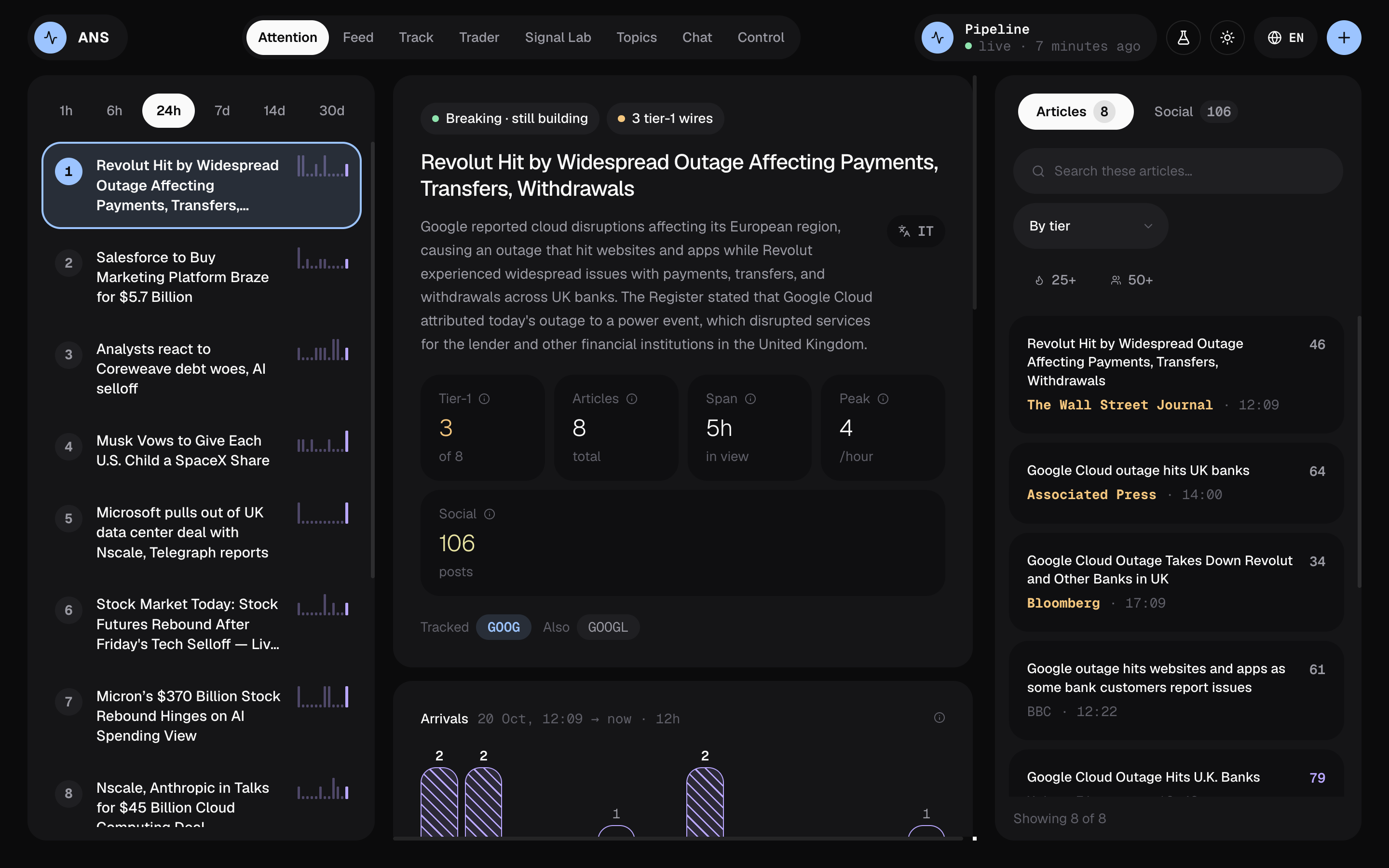
The question it answersWhat is everyone talking about?
A visual language for decisions, not just dashboards.
The Pencil design explores how to make dense information readable: three scores on a news card, price and news on the same timeline, a table for individual sessions and scoring rules that stay visible. Explore these original UI studies below.
Sample headline and values from the design file. Select a score to read its meaning.
How loud this story will be for ordinary people. Above 50 the crowd is talking; spread = retail − impact tells you whether that noise matters.
Control Panel ScoringPrice action, volume spikes and news days share one timeline. Toggle the chart layers to see how each carries a different kind of information.
Swipe sideways to inspect the full chart.
A common component language connects the product: rounded widgets, segmented controls, compact score bars and a consistent colour for each kind of information. The original design frames remain available beside the interactive versions.
Every generated text passes through validation before it reaches the trader.
An audit found moved numbers, invented companies and translation errors. We built a common path for model-written prose: write, validate, retry once, then fall back to computed facts. For paper trades, code also decides position size, stops and orders within the trader’s limits.
Change the model’s output. See what the code catches.
Company: Example Co.
Revenue: $12.4 million
Example Co. reported revenue of $124 million.
Blocked
$124m does not match the source value, $12.4m.
Rejected → one retry → computed facts if still invalid.The trader retired the spreadsheet. The system keeps reading.
In production since April 2026. The figures below are the project’s 20 October 2026 snapshot: almost all model calls run locally, with a fixed cloud cap for social research. A private product that can keep evolving with the person who uses it.
From the first screen
to the model behind it.
Tell us what you have in mind. We reply within one to two working days.
Next project
